Hi! My name is Antony. I am a graduate student at Vienna University of Economics doing a CEMS program exchange semester in Keio University in Tokyo, Japan.
Here I write about things related to Japan and Tokyo in particular: stories from exchange semester at Keio, about learning Japanese language and integrating with the culture and locals.
I have already mentioned Japanese Kanji in some previous posts. Once again, kanji are charachters used in Japanese language, they were borrowed from Chinese.
As once a week I have a Kanji class, all the time I discover something new. Until this moment I was always attempting to find logic that would help me memorize characters better. Sometimes it works, but often doesn't. For example this kanji means "alcohol"
this means a "person"
this means "fire"
this means "oil"
this means "sea"
Graphics of those kanji relate to the meaning behind them.
However more complex kanji comprising of other smaller kanji exists, making it more difficult to memorize. For example this kanji means "week":
The last category that I have uncovered is kanji that to me make no sense at all (to this moment). For example this one means "big"
and this one means "dog"
Is there a logical connection? The connection I am looking for is not there. However logic is still there: dog is a relatively new word in Japanese and when creating a character for dog they had to readjust some other character. This is how our kanji teacher explained relation of those two. But everything has a meaning and its purpose, we just need to search better to find it!
Beautiful sunny day in Tokyo. Today I woke up early as we were to meet Philipp to go to the training room together. Training room is a place on campus with different machines and weights, it is cheaper than a gym (300 yen per entry).
I had to wake up my buddy next door (Ondrej-san), otherwise he would sleep in our training. We left the dorm at 9:15 and at 9:30 were at the meeting point. Philipp didn't turn up for a while. But neither one of us yet had a phone and we didn't know where the training room was... So we had to return to the dorm and then go back out.
As it turned out, there is no way to get to the campus from the side of the street that we live in, you have to make a loop and go through the main entrance. This didn't stop us from climbing the fence and making our shortcut.
Training room (in Japanese "tureiningu rumu") was found on the first floor of student union building. From the inside the building was full with posters. People were playing musical instruments in the hall and everything looked really fun. In a while we found the magic training room. We entered to ask some questions. The lady there spoke really good English and explained to us the conditions. However she said the training room will open in 7 minutes and we had to wait outside... That is exactly what happened! In 7 minutes she took of the sign "closed" and invited us to go in. We paid our 300 jpy entry fee and enjoyed a great workout. By the way, most of the visitors of the training room that morning were foreigners.
SUPERMARKET OPENING
Under Motosumiyoshi dorm building on the first floor there is a supermarket. To be more precise, there in from today a supermarket: it just opened. The opening day was something special. Many Japanese people gathered in front of the store, most of them dressed up in suited. Lots of habitants of local neighborhood came with their bikes for the store opening. Apparently, this occasion is promoted very well in Japan and many people gather to get the good discounts on the opening day.
WELCOME CEREMONY
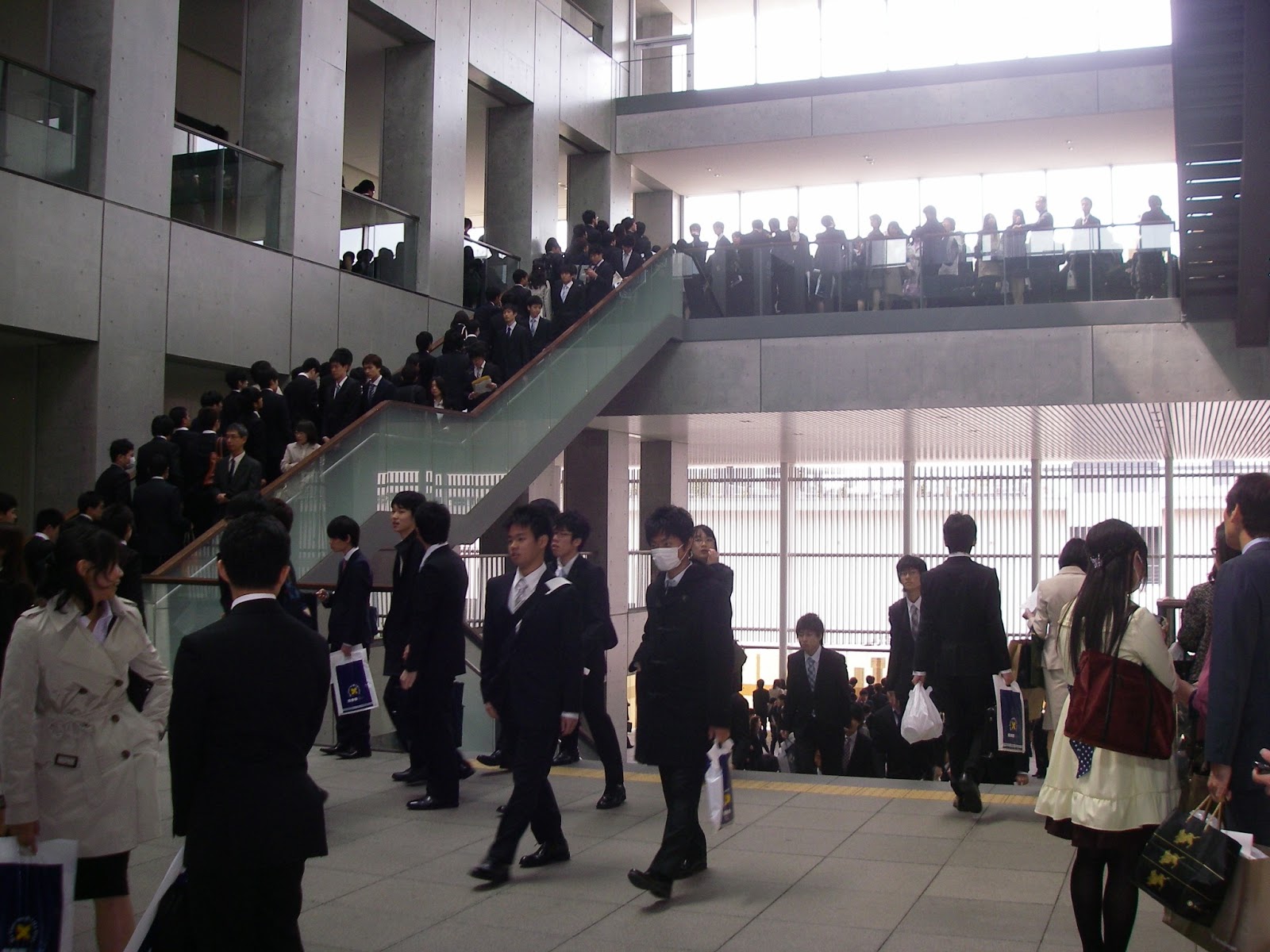
1st of April for us is fool's day, in Japan it is the first day of University in spring-summer semester. Today many Japanese students gathered for the welcome ceremony. Some of them came with parents.
Interestingly, all male students wear suits with ties. 99% of the suits are black. I can hardly remember anyone wearing jeans or something else than a suit. This is definitely different from the countries I have lived in. Going through a crowd of Japanese students in black suites was quite funny, reminded me Matrix somehow. =)
JAPANESE CLASS
There are plenty of Japanese classes available for exchange students. There are 2 groups of exchange students in Keio: Japanese Language Students and pert-time exchange students. The first group studies mostly Japanese Japanese-related subjects, while other group studies subjects in English but is allowed to participate in up to 2 Japanese language courses.
The timetables of available Japanese classless really bad... Many classes overlap with our regular CEMS classes, those which don't overlap, are simply held in another campus far away.
After deciding for a long time, I wanted to try Basic Japanese Conversation class. It seems, that my level is something in between 1 and 2: 1 seems too easy while 2 seems to hard...
We went to the class together with other CEMS students. The teacher (sensej) is a very nice lady with great sense of humor. The class was full of international people that never studied Japanese before (most of them) and many of the things seemed new to them. We discussed things like "my name is, I am from etc." It was pretty nice, but pretty basic... Now I am doubting event more, which class to choose.
GREETINGS
During the class the teacher we have rehearsed traditional Japanese greetings. Interestingly, for close friends and family there is a special word you use in the morning (short version of good morning), but during the day or afternoon you don't greet each other (family members and close friends).
This seemed quite strange to me, how can a husband in Europe come back from work and say nothing to his wife, and hear nothing back from her. Larry, our CEMS student from Taiwan and kanji-master, has explained, that in Taiwan it was the same. Once he said hello to his girlfriend and she got really upset, because she felt he had treated her as a stranger by greeting her. That's a WOW!
FEW RANDOM PICTURES
Office at metro station
Little screen showcasing a product
Keio University cookies set
RAMEN Traditionally after school we headed to eat at some new place. Our master of Kanji has taken us to a very famous ramen place. As usually, at the entrance there is a machine which takes your cash and allows you to choose ramen and drinks you want. The staff of the place was very hospitable in Japanese way, they even tried to speak English with us. We all ordered a bowl of ramen and rice as a side dish (for free). The plates were huge and full of food. Unintentionally I have ordered quite a spicy one so I had to swap with Larry, who felt it was absolutely normal. If you would come to this restaurant for the first time, you would think that those Japanese people are crazy. When you enter they all start screaming at you (in reality they are just welcoming a guest). The same is when you leave, all the restaurant staff starts screaming "goodbye" which for a person from the outside would seem really strange.
Photos by Larry Du
KANJI
Today we had a talk wit our Kanji-master, Larry. He is from Taiwan and he started studying kanji from elementary school. Now he knows around 8000 symbols. This right away puts him on advanced level of understanding Japanese writing as Japanese kanji are completely the same as Chinese ones.
However knowing kanji doesn't allow Larry to read things in Japanese properly. However I heard it takes much shorter to learn Japanese for people with Chinese or Taiwanese origin as they don't need to learn kanji at all, only their pronunciation.
Another interesting fact I learned, is that learning Japanese is easier for Taiwanese that for mainland Chinese people, as there are many similar words used in Taiwan (similar to Japanese).
The morning I decided to start with Japanese language. I went downstairs hoping to see some Japanese people with whom I could practice some Nihongo (Japanese language). Luckily, Masa was there, and he was happy as usually to help me out.
I taught him Russian alphabet. Japanese language doesn't have as many sounds as Russian does. But Japanese people are really good in writing, as they have to memorize thousands of Kanji (signs). They actually have to memorize not only kanji itself, but also stroke order in kanji. For some European student I had writing Russian alphabet was not that easy, but Masa easily copied all the letters that I wrote. He was only writing it in a little strange way, but the letters looked perfect.
In our dorm many devices talk to residents. For example water heater tells you something, elevator tells you something. I couldn't understand what they say, thus I asked Masa to translate it for me. Turned out, that the elevator was saying something "Please be careful, doors are closing(opening). Thank you" and floor numbers. The water heater in the bathroom was telling me not to forget to plug the bath before I turn on the water so that I don't lose water. Really funny stuff.
Shimoda party
Shimoda students village was having a party for exchage students today. So we went there of course... Hehe. For 500 JPY (4 euro) you got a name tag, snacks and unlimited alcohol. Unlimited alcohol was quite a fun one: 5 liter plastic bottles of whiskey, some Japanese beer with fruit flavors and 3% alcohol, juices, tequila and vodka. Mostly international students were there, however few Japanese also joined. In a while some of the students-organizers from Japanese side were out sleeping on the chairs.
We went quite strong with many "bottom-ups". The party started at 7 and at 9:30 organizers started to kick us out. It took around half an hour but they managed it. It was really fun but short party with magic whiskey that hits straight to head.
KAROKE
Some students headed to the center of Tokyo to a club. We decided to stay around Hiyoshi and a Japanese student purposed to take us to Karaoke. Japanese Karaoke!!! Yeahhhh
The Karaoke place was open till 5 in the morning and we arrived there around 12. We were split into groups (6-7 people per group). We stayed in our awesome CEMS group. The deal was: 10 Euro per person for 2 hours unlimited singing and one non-alcoholic drink included. There were many songs in English. On top of English words you could see Katakana (Japanese characters used for words taken from English). The remote control for choosing songs was complex as it's menu was completely in Japanese (mostly in Kanji) and we didn't have our master of Kanji (Larry) with us...
Somehow we managed to figure it out and had lot's of fun, especially singing Gangnam Style and some other songs, we have never heard before.
When we were leaving, the place still seemed busy. Many rooms were still occupied by Japanese singers. Seemed like there was only one guy there working, doing all sorts of activities from bringing drinks to cash desk.
RAMEN
Hiyoushi station is famous for its Ramen restaurants. Ramen is a soup with with noodles and often with meat or seafood. We were considering visiting Mc'Donalds, but our Japanese guide suggested to visit a ramen restaurant.
Imagine, 15 foreigners coming in a small ramen restaurant in the middle of the night (also drunk). To get ramen, you had to pay at a special machine at the entrance and then take a seat at a bar. The bar is built around the kitchen, so while sitting at the bar you can watch how everything is cooked. The workers seemed really friendly and happy to see us. For 600 JPY (5 Euro) we each received a huge plate of delicious Ramee soup and a bowl of rice to it. Few guys who didn't order anything also got some food for free. What a great place and great hospitality! The soup was really delicious and filling, exactly what we all needed after a drunken night.
I worked in a restaurant before in Russia and I know that employees and cooks are never happy, when a group of people comes in the middle of the night and orders something. I know that Japanese culture is absolutely different and based on mutual respect. Japanese workers of Ramen restaurant showed great hospitality, but I am still wondering, if it was on the outside only. What were they thinking? "Stupid foreigners came here, why!!!" or they didn't think this way... Hope that by the end of this Japanese journey I will be able to understand people here a lot better.
This morning we had to take a Japanese placement test in order to determent our level for language classes. In orded to come to the test, we needed to register beforehand online. Than we had to remember the registration number, print out a registration form, fill it out, adding the registration number and glueing a photo not older than 3 months. We were also required to bring copies of two sides of our residence card (this is how mine looks like) and student card (here it my student card). Luckily, there are printers and copy machines in every convenience store around. I went to one early this morning. I was able to make copies easily (5 yen per copy) and wanted to print from usb stick... DIdn't work out. I asked the employee of the store to help me, she struggled. Then the head of the store came, but he also wasn't able to figure out how to print the thing... So I left without accomplishing such an important task.
To be ontime for he test and print out our documents on the way, me and Ondrej left our dorm a little earlier. However after a few minute of walking, I realized that I forgot to take my registration number (which was written on a piece of paper). On the way back somehow a folder with Ondrej's documents opened and some of the papers flied away... It was sooooo fun to look at a white guy running around in the middle of the busy crossroad trying to chase some papers that kept flying away from him. In the end we made it: papers were collected, forms were printed out in another convenience store.
We arrived at the test place 10 minutes before it's start. Registered. Each student was assigned a seat in a room according to registration number. When everyone was there, a Japanese guy in a suit started his announcement. Regardless of the fact, that some of the people in the room spoke zero Japanese, he started to say everything in Japanese (however translating after to English). The best thing was when he said in Japanese: "those who have never studied Japanese please leave the room and go to another one". =)
The test was quite difficult from my point of view with a lot of guessing. In had a listening comprehension and grammar part in it. The second part of the test was for more advanced students (composition). All not advanced students were allowed to leave the room after the first part of the test was over.
BANK
Opening a Japanese bank account was required. Even though, we are staying here for only 4 months, university staff said, that we might get permission to open an account (sounds promising).
We arrived in a bank with a group of international students. The bank was located close to Keio university, thus they had lots of experience dealing with internationals. They counted us, gave us a number and after sometime invited all to come to special backroom. We all were given a sheet of paper to fill out. As usually, only in Japanese. The lady could also only speak Japanese. Lukcily, we had a sample on the table and some of us knew some kanji (so not all of us simply copied gender as female to our forms). We stayed there for about an hour filling in the form. The lady asked, if someone wanted a credit card. Few guys did. They have received another long form completely in Japanese. Lol
In Japan most of the people have their personal stamp (seal) that they carry around. As we didn't have one, we had to come up with a 4-digit number and our signature to it. From now on it was our stamp-signature for bank purposes.
It seemed, that even that people didn't speak much English, they were extremely nice, polite and willing to help. Great experience.
LIVING IN JAPAN: ORIENTATION FOR INTERNATIONAL STUDENTS
All exchange students had to attend an orientation session about Japanese culture.A very funny a nice lady with perfect English and Filipino origin has told us many interesting things about Japan. Here are few that she has mentioned:
- girls shouldn't ride a bicycle with knees out (knees got to be facing inside)
- expectations don't always match reality. Don't be biased. Don't expect too much and too high.
- in general things take a long more time in Japan than in Europe
- Japanese seem to love rules and regulations. They have so many of those.
- what Europeans consider polite can be different here, beautiful and ugly, delicious and bad tasting are also different.
- event time vs. actual time. Japanese are very punctual, but some of them live not by actual time, but by event time. It means that next event starts only after another is finished.
- in the supermarket you don't necessarily have to say thank you. They don't expect that. You don't have to respond to the nice gestures in the stores or to the words.
- plants in pots are not allowed to bring to the hospital when you are visiting because it means that you want the person to stay there longer.
- Japanese people have special envelopes for funerals and for wedding. You are supposed to put money in that envelope. How much money? It is always written on the back of the envelope.
- another tabu is to stick chopsticks in a bowl of rice. This is done when someone died.
SIGHTSEEING
As we were already in the center of the city and transportation was extremely expensive, we decided to have a look around. A 15 minutes walk took us to a beautiful tower with a great view from the top (which we didn't enjoy as we didn't go up).
After visiting the tower, we headed to one of the most beautiful locations in Tokyo during this season : Naka-Maguro metro station. There along the river a garden of cherry trees is planted. THat place is simply amazing! Blooming sakura lighted up with Japanese traditional orange lights. It felt like warm Christmas time, as people were walking around enjoying the view and drinking champagne from glasses. The place is very romantic and many Japanese people came there with their girlfriends. Some have made a picnic along the cannel right on the asphalt.
Being tired from a long day, we decided to make a stop and eat something traditional. Luckily we had Larry with us who was in Japan before. We found a restaurant that Larry knew ( a chain restaurant) and went it. It was a great choice. TO get to the table, we had to take off our shoes and place them in a special box. From the menu we ordered one from everything and decided to share all meals to try it all. Really amazing meal! Here are a few pictures. Thanks to Larry and a great company!
LANGUAGE LESSON AND ORIGAMI
The day was not yet over. Downstairs in our dorm we met some Japanese people and decided to chat with them. After Kotani family came down and brought some tea and sweets.
I have asked them about origami. Turned out, that Kotani-san's wife has many books and knows a lot of origami. When I was little, my grandmother brought a huge box of origami paper and a book from Japan. I used to do that often and now it reminded of my childhood.
As we had a great opportunity, we decided to study some Japanese with locals. Ondrej who speaks 0 Japanese was wondering about pick up lines in Japanese and was tought things like: "You are beautiful" and "let's go with me for a cup of green tea". Very interesting culture that I begin to fall in love with more and more.




.jpg)
.jpg)
.jpg)


